History of the Village Cup
While cricket has changed considerably since 1972 – County Championship matches were three-day affairs and coloured kit was the result of a laundry malfunction – the Village Cup has retained its founding principles.
The 40-over knockout was conceived by then-owner of The Cricketer Ben Brocklehurst, who secured MCC’s support to host the final at Lord’s. Ben’s wife Belinda ran the competition for the first seven years and, forgetting 2020, still attends the final each year.
Two-thousand village clubs were contacted in 1971 and 785 clubs enlisted.
A village was defined, with a “rural community surrounded on all sides by open countryside” being a requirement, and limited population to 2,500. Those requirements largely remain in place, though 2,500 is now 10,000.
The purpose of the competition is unchanged: to provide opportunities for village cricketers and the chance to play at Lord’s.
Cornish side Troon won the inaugural National Village Championship (‘Village Cup’ would be adopted in 2004). Opponents Astwood Bank made national headlines after refusing to bat, finding the band of the Grenadier Guards too distracting.

The Troon side that won the inaugural Village Cup in 1972
Troon would defend their title in 1973, overcoming Gowerton. They won a third title in 1976 and lost to Quarndon in the 1983 final.
Haig were sponsors until 1977 before Whitbread replaced them in 1979. The competition was known by clubs, however, as ‘the Haig’ well into the 1980s.
Whitbread ended their sponsorship in 1984 and from there sponsors included Norsk Hydro, Rothmans and Alliance & Leicester. Energy firm npower took over in 2004 and combined sponsorship with England’s home Tests. In more recent times Yorkshire Tea, Davidstow, and Watsons Dairy were sponsors.
Rural broadband experts Voneus will sponsor the 2021 and 2022 competitions.
The competition has seen winners up and down Britain. Scotland’s Freuchie beat Rowledge in 1985 on wickets remaining in the most thrilling climax at Lord’s until the 2019 World Cup final.

Marchwiel win their second title in 1984, collecting a rather perculiar cricket-themed trophy
Wales has a strong pedigree, with five clubs lifting eight titles. Sully Centurions were the last Welsh side to win, in 2004. St Fagans, near Cardiff, matched Troon’s three titles in 1991, having triumphed in 1981 and 1982.
Perhaps unsurprisingly, Yorkshire has been the most successful region in the competition with 12 titles – eight coming since 2005. Reed of Hertfordshire have often been the Yorkshire disruptor, winning three titles during the 2010s.
The most successful club in the competition’s history is Yorkshire’s Woodhouse Grange. They have won four titles in 1995, 2007, 2014 and 2015.
Lord’s has brought out the best in some players: In 1990 Goatacre’s Kevin Iles hit the then-fastest hundred at Lord’s, in 39 balls. It helped Goatacre secure their second Village Cup, with Iles hitting 91 not out to help win the 1988 final. Only Sessay’s Simon Mason has eclipsed Iles’ 123, the opener scored 138 in 2016 versus Sibton Park.
Of course, the competition is not just about Lord’s. Thousands of cricketers take to village greens, and it highlights the best, and the plucky.
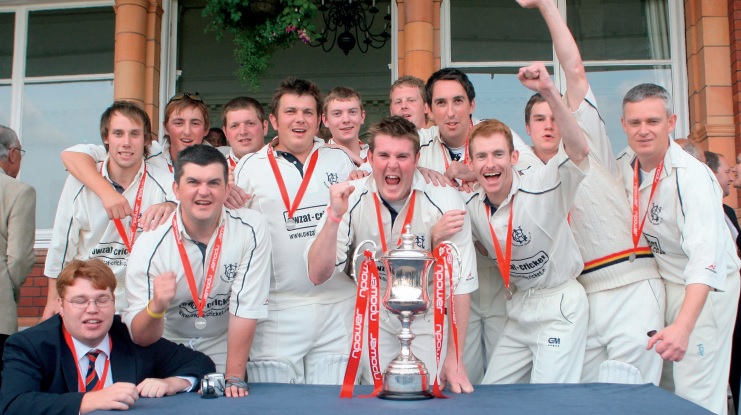
Four-time champions Woodhouse Grange celebrate their second title in 2007
There have been routings: in 2015 Himley scored 480 for 4 (the record score) before dismissing Hinstock for 65, the 415-run winning margin also a record.
Five clubs have been dismissed for single figures, the lowest being Marston St Lawrence’s 6 versus Abthorpe in 1978.
It also pairs the best: in 2017 Essex clubs Horndon-on-the-Hill and Belhus scored 648 runs as Horndon chased 324 two wickets down. As with professional cricket, run rates have increased, with only two of the top 20 aggregates coming before 2000.
In 2020, the Village Cup was the only nationwide cricket competition played during the Covid-19 pandemic – clubs involved pulled off an unlikely seven rounds in seven weeks before the final on September 19.
The final was one of seven matches played at Lord’s in 2020 and the only non-professional game. Herefordshire’s Colwall won a tense final. Credit must go to MCC for its commitment to the competition, especially in such a difficult year.
In 2023, Milford Hall emerged victorious in a low-scoring thriller against Leeds & Broomfield to inherit the trophy from Dumbleton, who had beaten 2021 champions Calmore at Lord’s 12 months earlier.
2025 saw Foxton Granta become the sixth side to defend the title they first won in 2024, while Richard Kaufman made his own history by becoming the first man to score back-to-back centuries in both finals.